

Getting reviews and getting edited—a reality check
The numbers behind a real review campaign, plus expectations for working with an editor
In this week's Shining Beacon, I'm guiding you through the storms of unrealistic expectations for getting reviews and for working with an ditor.
As always, I welcome questions, so comment below or email me.
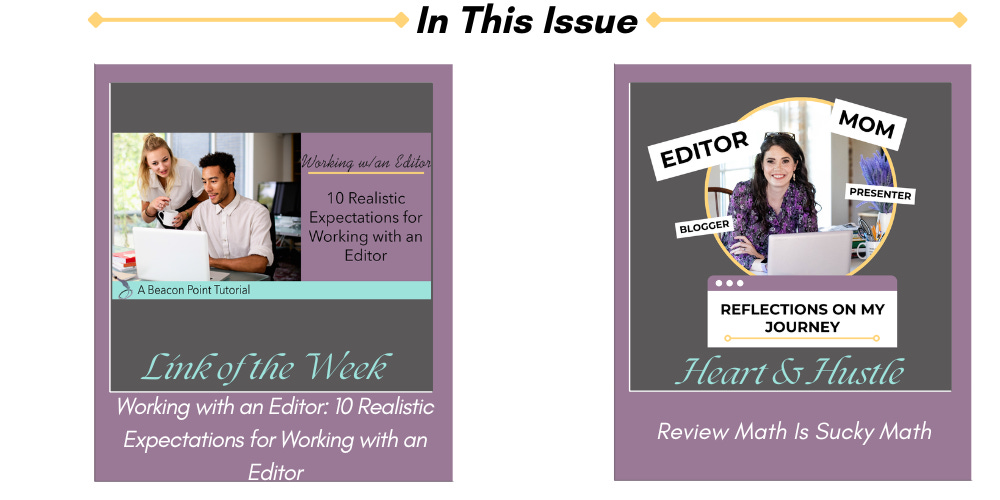


Lessons from the messy middle. These reflections come from pouring my heart into my business, serving editors and authors with everything I’ve got, and hustling to grow and light the way for others doing the same.

Review Math Is Sucky Math
I have given away 238 copies of my two books. For free. And I plan to give away more.
Eighty-seven went to my launch team during my soft launch in February, and 70% of them came through with reviews. Sadly, not all of them could get those reviews published on Amazon.
The remaining 151 copies went out into the world with a general ask: If you get around to reading it, I’d love a review.
So far, 3 have left reviews, and 8 have been marked as no. The rest are still getting around to it. Totally fair. Life is busy. I send the first ask two months after they got the book, then will follow up two more times, spaced a month apart, before I mark them as a no.
I also listed both books on GetBooksReviewed and Gemsy. 4 reviews have come in through GBR, and Gemsy already has 4 readers signed up, and I just listed them 3 days ago (if you want to check out Gemsy, hit up Dale L. Roberts. He has a coupon code for it).
My goal was 50 reviews per book by the end of August. I’m at 40 for Self-Editing Essentials for Fiction and 45 for Self-Editing Essentials for Nonfiction, which means I need 15 more. The frustrating part is that I’m actually closer than those numbers show. Some reviews are only on Goodreads. Some are on international Amazon marketplaces that didn’t get factored into the US count. If all reviews showed up in one place, I’d already be past 50 on the nonfiction book and just two away on fiction.
Amazon, if you’re reading this: Please fix that.
I’m not sure I’ll hit 15 more before August ends. Summer is a reading slowdown, and people are busy. But I’ll keep asking and giving it my all. No one else is going to hand me my dreams. I have to make it happen.
I never used to leave reviews before I became an editor (my goal now is to leave two reviews a month for indie authors). So I get it. But man review math is sucky: 1 review for every 100 readers. I gave the books away to 238 and have sold 792, which is 1,030. That would mean only 10 reviews, but I’ve worked really hard to get the 85 I have.
Lesson for you:
👉 Seeding your book matters even when it doesn't immediately convert to reviews. Every copy in someone's hands is a potential word-of-mouth moment. The reviews are just one measure of what's happening out there.
❓ Have you asked your readers for a review lately? If not, what's standing in the way?

Working with an Editor. 10 Realistic Expectations for Working with an Editor
Working with an editor for the first time can feel vulnerable, as handing over your manuscript takes trust. This tutorial walks you through ten realistic expectations for the editing process, from what "better" actually means after a round of editing to why editors cost what they do.
**Yes, usually the link of the week is content from another industy professional and not from me. I cheated. Sorry I didn't have the time to read through content from others this week.
✨ Try this:
Before you hire your next editor (or reach back out to one you’ve worked with before), run through these questions:
Do I know what type of editing I actually need: developmental, line editing, copyediting, or proofreading?
Have I communicated how hands-on I want my editor to be, or assumed they’d just know?
Am I expecting one round of editing to make my manuscript publication-ready?
Do I understand that I’ll still have revision work to do after I get it back?


Word Track Changes
The industry standard is Word. Word track changes has features that are helpful to editors plus they can use macros (not AI) inside Word. Not all editing macros are compatible with Google Docs, the Google comment structure is harder to follow, and it can strip out formatting. Some editors refuse to work in GD. Some will work in it, while others will only do it for an extra charge.
If you're unfamiliar with Word Track Changes, see this lesson on how to use it. It’s one of the lessons inside my email course on working with an editor.

If you’re reading this on Substack and aren’t yet a subscriber, check out my About page to learn all the reasons you should subscribe and subscribe below.
Thanks so much for the shoutout!